


Why Genetic Testing May Miss Neurofibromatosis Type 1: How WGS Helps Detect Hidden NF1 Variants
ยาความแม่นยำ
•
2026-05-21
Different variants in the same NF1 gene may require different levels of genetic analysis. Whole genome sequencing may help uncover variants that conventional testing can miss.
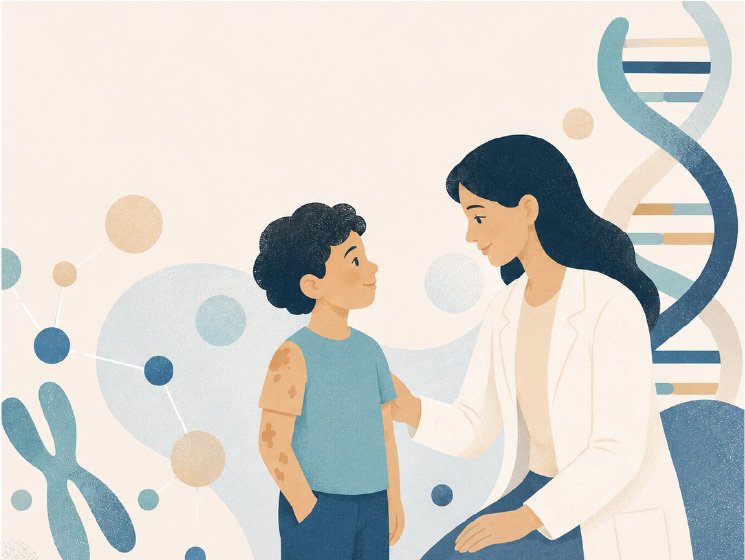
Why Genetic Test Reports May Show “No Variant Detected” Despite Typical Signs of Neurofibromatosis Type 1
In clinical practice, some patients present with features highly suggestive of Neurofibromatosis Type 1 (NF1), such as café-au-lait macules, neurofibromas, or other characteristic findings. However, after undergoing a routine gene panel or Whole Exome Sequencing (WES), the genetic test report may return with the result: “No pathogenic variant detected. This can be confusing and frustrating for patients and families.
Does this mean the clinical suspicion was wrong?
Was the genetic test inaccurate?
Or is the underlying genetic cause still hidden?
In many cases, the issue may not be that the diagnosis is impossible to confirm. Instead, the limitation may lie in the detection scope of the testing method. Even when the same condition and the same NF1 gene are involved, disease-causing variants can appear in very different forms. Some are easier to detect with conventional methods, while others may require a more comprehensive genomic approach.
Understanding NF1 variants: one gene, many possible variant types
The NF1 gene can be thought of as an instruction manual that helps guide normal cellular function. When there is an error in the manual, the instructions may be disrupted.
However, not all errors look the same.
Some are like a small typo. Others are like an entire page missing. Some may even be hidden in the margins — outside the areas that certain tests routinely examine.
This is why different variant types can lead to different diagnostic challenges.
Variant Type 1: A small “typo” in the gene
Some NF1 variants are small changes in the DNA sequence, such as single nucleotide variants (SNVs) or small insertions and deletions (indels).
These are similar to a missing or incorrect letter in a sentence. Even a tiny change can shift the reading frame or alter the resulting protein, potentially disrupting normal NF1 gene function.
Routine gene panels and WES are generally effective at detecting many of these smaller coding-region variants. In cases where the disease-causing change is located within the regions targeted by the test, these methods may provide a clear molecular diagnosis.
Variant Type 2: A “missing page” in the gene
Other NF1 variants are larger changes, such as copy number variations (CNVs) or structural variations (SVs). These may involve deletion or duplication of one or more exons, or even larger genomic regions.
Using the manual analogy, this is like discovering that an entire page — or even a larger section — has been removed from the instruction book.
These larger variants can be more difficult for some conventional testing approaches to detect, depending on the platform and analysis method used. In the past, patients with unresolved results might have needed additional tests such as MLPA or chromosomal microarray analysis (CMA) to evaluate these types of changes.
Variant Type 3: A hidden error outside the usual reading area
Some disease-causing variants may be located outside the protein-coding regions, such as deep intronic variants. These variants are not found in the exons themselves, but they may still disrupt how the gene is processed or expressed.
This is like an important instruction hidden in the margins of a book. If the test only reads the main printed text, it may miss the problem.
Because WES primarily focuses on the protein-coding regions of the genome, certain deep intronic variants may be difficult or impossible to detect through WES alone. For patients with strong clinical suspicion but negative prior testing, this limitation may be clinically important.
Why whole genome sequencing may help
When a single gene such as NF1 can be affected by multiple variant types, a broader testing strategy may be needed.
ACTInherit (Whole Genome Sequencing) is designed to analyze the genome more comprehensively, including coding and non-coding regions. By providing a broader genomic view, WGS may help detect a wider range of variant types, including SNVs, indels, CNVs, structural variants, and selected non-coding or intronic variants, depending on the case and analysis strategy.
Rather than evaluating only selected genes or regions, ACTInherit supports a more comprehensive approach to complex or unresolved hereditary disease cases. For patients and families who have undergone multiple tests without a clear answer, this broader analysis may help reduce repeated testing and provide a more complete basis for clinical interpretation.
When should broader genomic testing be considered?
Broader genomic analysis such as WGS may be worth discussing with a healthcare professional or genetic counseling team when:
• clinical features strongly suggest a hereditary condition, but prior genetic testing was negative
• NF1 or another genetic condition is suspected, but gene panel or WES results were inconclusive
• previous testing did not include CNV, SV, or non-coding variant analysis
• symptoms involve multiple systems or do not fit a simple diagnostic pattern
• there is a long diagnostic journey with repeated testing and no clear molecular explanation
The goal is not simply to perform “more testing.” The goal is to choose the right level of testing for the clinical question.
Finding the right tool for the diagnostic journey
For families affected by rare or hereditary diseases, a negative genetic test result can feel like the end of the road. But in some cases, it may simply mean that the right variant type has not yet been captured.
A more comprehensive genomic approach may help clinicians and families revisit unresolved cases with a broader lens.
With the right testing strategy, previously hidden genetic answers may become visible.
If you or a family member has experienced a long diagnostic journey, received inconclusive genetic test results, or is suspected of having a hereditary condition such as Neurofibromatosis Type 1, speak with a healthcare professional about whether ACTInherit (Whole Genome Sequencing) may be appropriate.
To learn more about ACTInherit (WGS), please contact ACT Genomics’ Genetic Counseling team.
Disclaimer
This content is provided for informational purposes only and does not constitute medical advice, diagnosis, or treatment recommendations. Any testing or treatment decisions should be made by qualified healthcare professionals based on each patient’s individual condition and the latest clinical evidence.
.jpg)
.jpg)


